Career · Machines, transport and industry
Robotics engineer
Combines mechanics, electronics and programming so a robot can perform a useful task safely and accurately.
What a day looks like
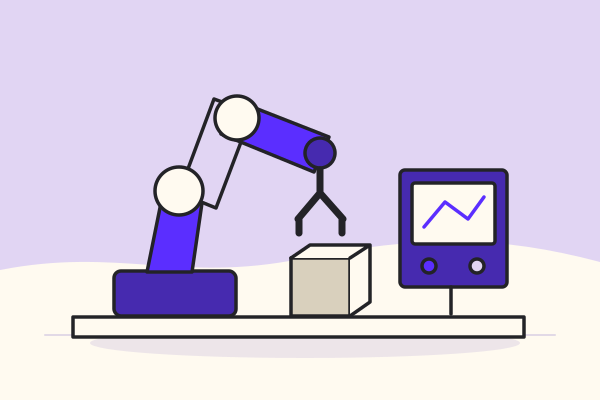
Imagine an engineer tuning a teaching prototype that sorts small components. This is an example of a workflow, not a description of a particular factory. The morning begins with agreeing on requirements: which objects should the robot recognise, where should it move them and what should happen if a sensor fails? Speed is only one consideration. Safe stopping and test conditions must be defined before motion starts. The engineer checks the gripper drawing, connections and saved programme version.
During the first test, one object slips. Instead of rewriting everything, the engineer compares gripper shape, object position and sensor readings. Test conditions are recorded, one parameter is changed and the trial is repeated. A fault that looks like a software problem can have a mechanical cause. After several trials, the team finds a stable solution and tries other objects. Reliability is assessed over repeated attempts rather than one successful movement.
In the afternoon, the engineer uses modelling software, adjusts a mounting dimension and discusses the change with an electronics colleague. The control algorithm is updated, backed up and checked for a missing object. Real equipment is tested in a suitable area under workplace procedures; home practice should not imitate hazardous industrial operations. The day ends with a test log, remaining limitations and instructions for the next trial. The work offers tangible results, but also involves patient measurement, documentation and troubleshooting. Even a small robot brings several kinds of expertise together.
Try it yourself this week
30 minutes
Look closely at a mechanism and draw how it works
- Choose a simple thing at home: a door lock, a bike or a desk lamp. You don't need to take anything apart, just look.
- Draw the whole thing and label the main parts.
- Use arrows to show what passes movement to what: for example, where you press and what moves.
- Write down three questions you don't know the answer to, and find the answer to one of them.
What you'll learn about yourself: Whether you're drawn to finding out how things work inside, and whether you have the patience to get to the cause.
30 minutes
Draw a sketch of a shelf bracket with measurements
- Find a shelf or stand at home and look at what holds it up. Don't unscrew anything.
- On squared paper, draw a side view and a top view of a bracket that could hold a shelf like this.
- Mark the measurements with arrows. To get them, measure the real shelf with a tape measure.
- Think it over and write down: which part takes the most load, and how would you make it stronger?
What you'll learn about yourself: Whether you find it interesting to be precise and to think about strength in advance.
What you can do next
Next 3 months
Examine a safe mechanism
Complete t13 with a switched-off household mechanism without opening electrical parts. Draw how its parts move.
Prepare a drawing
Complete t07 and label dimensions. Check whether someone can understand the shape and mounting.
Describe control on paper
For an imaginary sorter, write the sensor input, action and safe response to an error.
In six months
Try a software model
Create a simple movement or command simulation. Test normal operation and a missing input.
Keep a test log
Record ten repeats of an experiment, including conditions, results and changes. Change one parameter at a time.
In a year
Build a prototype portfolio
Combine drawings, code or simulation, a test log and limitations. Find a supervisor for real equipment.
Compare engineering programmes
Read two curricula for mechanics, electronics, control and laboratory work. Confirm current admissions rules.
What it pays
No verified information is available in this section yet.
Where to study
Universities
You apply after grade 11, based on your UNT results.
- Satbayev University (opens in a new tab)
Almaty
Robotics and Mechatronics — undergraduate
- Nazarbayev University (opens in a new tab)
Astana
Robotics Engineering, Bachelor of Science
An undergraduate programme in robotics engineering. Check current admission conditions with the university. Admission requirements (opens in a new tab)
How to get into college
College gets you a profession faster than university. You can apply after grade 9 or after grade 11.
- Colleges accept students both after grade 9 and after grade 11. After grade 9 you study longer — about 3 years 10 months; after grade 11, about 2 years 10 months. The exact length depends on the college and the specialty.
Source: kchk.edu.kz (opens in a new tab) - About 80% of students admitted to colleges in the 2024/25 school year study on a state order, which means in state-funded places (in 2023/24 it was about 70%). But each college and each specialty has its own number of state-funded places.
Source: inbusiness.kz (opens in a new tab) - There are also paid colleges. For example, training as a nurse at ADILMED costs 450,000 ₸ per year. Check the price and conditions on the college's website.
Source: adilmed.kz (opens in a new tab)
UNT: which subjects to take for university
The UNT (Unified National Testing) is Kazakhstan's national university entrance test. You need it to get into university after grade 11.
- The UNT 2026 has three compulsory subjects: History of Kazakhstan, Reading Literacy and Mathematical Literacy. On top of these, you take two profile subjects, chosen to match your specialty.
Source: testcenter.kz (opens in a new tab) - In total, the test has 120 questions (maximum 140 points) and you get 4 hours. The format is the same as in 2025.
Source: testcenter.kz (opens in a new tab) - Profile subjects depend on the group of specialties. For example: information technology — Mathematics and Computer Science; nursing and veterinary medicine — Biology and Chemistry; electrical engineering — Mathematics and Physics; law — World History and Fundamentals of Law. The full list is published by the National Testing Center.
Source: testcenter.kz (opens in a new tab) - For creative specialties (for example, media and design), you take History of Kazakhstan and Reading Literacy through the UNT, and two creative exams at the university itself.
Source: testcenter.kz (opens in a new tab) - Some universities have their own admission rules. Nazarbayev University, for example, requires a UNT score of at least 85, a GPA of 4.0 and English at IELTS 6.0 level.
Source: nu.edu.kz (opens in a new tab)
Courses and opportunities
Opportunities near this field
- Programmeenbek.kz job portal (opens in a new tab)
Министерство труда и социальной защиты РК
Who it's for: anyone looking for a job or an internship.
When: all year round.
The government job vacancy portal. It has a section for students and young specialists called «Жастарға» (For young people).
Checked: September 2026
Source: enbek.kz (opens in a new tab) - Programmeup to age 35Youth internship programme (opens in a new tab)
Министерство труда и социальной защиты РК
Who it's for: college and university graduates (not for school students).
When: ongoing, up to 12 months.
A paid internship for graduates (under the terms on enbek.kz, at least 30 MCI (monthly calculation index) per month). The rules have changed before, so check them on the day you apply.
Checked: September 2026
Source: enbek.kz (opens in a new tab) - Programmeup to age 35First job programme (opens in a new tab)
Министерство труда и социальной защиты РК
Who it's for: young specialists (not for school students).
When: subsidy for up to 18 months.
The state helps pay a young specialist's salary for up to 18 months. Check the conditions on enbek.kz.
Checked: September 2026
Source: enbek.kz (opens in a new tab) - ProgrammefreeAtlas of New Professions (opens in a new tab)
Минтруда РК и Центр развития трудовых ресурсов
Who it's for: everyone.
When: reference guide, always available.
Atlas of New Professions: which jobs will appear, change or disappear in the next 5–10 years. Free to read.
Checked: September 2026
Source: atlasbt.enbek.kz (opens in a new tab)
Can you work before you turn 18?
Under Kazakhstan's Labour Code, teenagers can work, but with limits.
- Usually you can work from age 16. From 15 — if you are getting basic or general secondary education. From 14 — only in your free time outside school and only light work. If you are under 16, you need a signature from a parent or legal guardian.
Source: kodeksy-kz.com (opens in a new tab) - From 14 to 16 you can work no more than 24 hours a week; from 16 to 18, no more than 36 hours a week.
Source: kodeksy-kz.com (opens in a new tab) - Under-18s must not be given heavy or hazardous work, jobs with full financial liability, night work, overtime or business trips.
Source: mybuh.kz (opens in a new tab)
History of the career
A major landmark in industrial robotics was the installation of Unimate at a General Motors plant in 1961. IEEE Spectrum describes it removing castings from a press, taking over a repetitive and hazardous task. Its development involved inventor George Devol and engineer Joseph Engelberger, the cofounders of Unimation.
Modern robotics is much broader. O*NET lists system design, sensor processing, programming, testing and maintenance. Kazakhstan’s degree programmes combine mechanical, electrical and computing disciplines. The history illustrates both growing machine capabilities and the continuing need for people who define requirements, verify behaviour and consider safety.
Well-known people in this field
Joseph Engelberger
Engineer and Unimation cofounder involved in developing and introducing the Unimate industrial robot.
Source: spectrum.ieee.org (opens in a new tab)George Devol
Inventor of a programmable manipulator and Unimation cofounder associated with Unimate.
Source: spectrum.ieee.org (opens in a new tab)
Article sources
- O*NET: robotics engineer duties (opens in a new tab)
Checked: 2026-10-04
- Satbayev: Robotics and Mechatronics (opens in a new tab)
Checked: 2026-10-04
- NU: Robotics Engineering (opens in a new tab)
Checked: 2026-10-04
- IEEE: Unimate history (opens in a new tab)
Checked: 2026-10-04